

New Delhi [India], July 28: Type a comparison question into ChatGPT or Google’s AI Overviews today, and you’ll often get a full answer with a brand name attached before you ever open a browser tab. For the person asking, that’s convenient. For the brand that didn’t get named, that’s a customer lost without ever knowing there was a chance to win them.
This is the shift underway in B2B marketing right now. Search hasn’t gone away, but a growing share of it resolves inside an AI answer instead of a results page. Ranking first on Google means less than it used to if the AI answering the question cites someone else.
Traditional SEO was built around keywords, backlinks, and ranking signals, all aimed at a page of ten blue links. Generative Engine Optimization, or GEO (some call it AEO, Answer Engine Optimization), is aimed at something different: whether a language model trusts a brand enough to name it when generating an answer. Getting there takes a few things a keyword strategy alone doesn’t cover:
- Entity clarity — the model needs to understand who you are and how you sit relative to your category, beyond which terms you rank for
- Topical authority — a connected body of content, built as a network, rather than a scatter of standalone landing pages
- Extractability — content structured so a model can pull a direct answer and attribute it correctly
- Citation visibility — AI citations don’t show up in a standard analytics dashboard, so tracking them is a new problem in itself
Most agencies have responded by pasting “AI” language onto their existing SEO service pages. That doesn’t actually solve any of the above. A handful of agencies have instead built their whole approach around it, and Qoulomb is one of the more established names doing that work.
Qoulomb is a B2B-focused GEO and SEO agency working with companies ranging from venture-funded startups to Fortune 500 enterprises across 13+ industries, including AI & Tech, SaaS, fintech, healthtech, legaltech, edtech, and manufacturing. The agency has worked with 200+ B2B clients, including Samsung, Zetwerk, Slice Bank, Cybertech, and GAIN Servicing, and maintains a 4.9-star Clutch rating.
Qoulomb runs GEO and SEO as one integrated system rather than separate workstreams, tracking brand citations across ChatGPT, Perplexity, Google AI Overviews, Microsoft Copilot, Gemini, and other AI search experiences. Its reporting connects AI visibility directly to pipeline and revenue instead of stopping at citation counts.
The agency has documented results such as a 2,217% increase in AI-driven traffic for Zetwerk over nine months and reports generating over $17.3 million in client revenue in the last quarter by treating AI search visibility as a revenue growth channel rather than a traffic metric.
The following client engagements give a sense of what that’s actually produced:
Zetwerk
A global manufacturing unicorn, needed visibility among enterprise procurement leaders across the US and Europe, an audience that’s hard to reach and easy to lose to competitors already established there.
Qoulomb ran a full-funnel SEO and content program, then moved it into a dedicated GEO phase once the foundation was in place.
Within six months, traffic grew 2.3x, over 960 new keywords started ranking, and organic impressions jumped 8x, with monthly traffic exceeding 41,600 visits across more than 600 published assets.
CXO and VP-level inquiries grew 5x, and US traffic climbed from 10% to 38% of the total. Once the GEO phase took hold, Zetwerk’s AI-sourced traffic grew 2,217% over nine months.
Elchemy
Elchemy had built a strong content library but remained stuck on page two of Google and was rarely cited by AI platforms despite serving global B2B chemical buyers.
Qoulomb ran a five-month SEO and GEO program focused on buyer-intent content, technical optimization, and AI-ready content. Organic clicks increased 93%, search impressions grew 155%, and average rankings improved from position 10.8 to 6.5, moving much of the site’s content onto page one.
The GEO program also increased Elchemy’s AI visibility dramatically. AI-cited pages grew from 368 to more than 4,500 across ChatGPT, Gemini, and Google AI Overviews, while AI prompt rankings expanded from just 18 to over 9,000 within five months.
GAIN Servicing
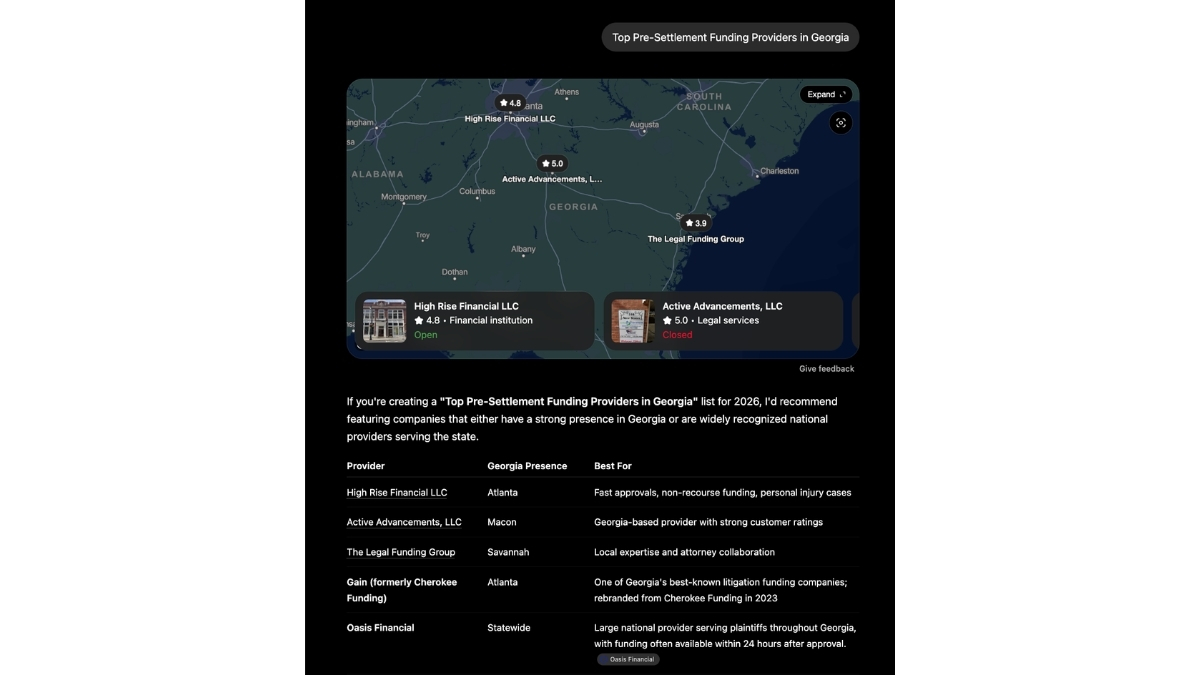
GAIN started in a much harder spot. Operating in a competitive healthcare and legal-tech niche, it had roughly 489 monthly organic visits and 35 leads a month, no content strategy, and no presence in AI search at all.
It was leaning on paid acquisition just to keep the pipeline moving.
Over an eight-month integrated SEO and GEO campaign, GAIN increased monthly lead generation from 35 to approximately 280 leads per month. By the end of the campaign, organic search had become the company’s primary acquisition channel, generating more than 1,100 leads over the course of the campaign without paid acquisition.
TrueLoyal (Previously Zinrelo)
TrueLoyal, an enterprise loyalty and retention platform, had limited brand recognition among the buyers it needed and no footprint in the AI research those buyers were starting to rely on. Qoulomb rebuilt its content architecture around enterprise SaaS buyers specifically.
Website traffic grew 35%, more than 300 new keywords started ranking, conversions on enterprise landing pages rose 37%, user engagement grew 2.3x, and revenue from enterprise SaaS clients doubled. The strategy reportedly paid for itself within three months, off the strength of a single inbound deal.
Why the Results Hold Up
Company-wide, Qoulomb’s active accounts show a 5x average organic growth rate and $17.3 million in pipeline generated last quarter alone, with client retention averaging 2.5 years, roughly double what’s typical for marketing retainers.
About half its current clients are based in the US, despite the agency itself being headquartered in India, which points to something worth noting on its own: American SaaS and tech brands are increasingly picking GEO specialists based on track record rather than location.
What ties clients like Elchemy, Zetwerk, GAIN, and TrueLoyal together is a deliberate approach to AI search. Rather than treating AI citations as a byproduct of traditional SEO, they built visibility across AI platforms intentionally, measuring AI presence alongside conventional search metrics.
If you object to the content of this press release, please notify us at [email protected]. We will respond and rectify the situation within 24 hours.

Comments are closed.